

Raise your arm if your shoulder hurts
Pain spoils the fun. But it also spoils the work-day. If you’re having pain in the shoulder, then the irony of the title of this piece is not lost on you. Raising the arm overhead really hurts. It’s such a common problem that I thought I’d take a moment and explain one of the reasons we develop pain in the top of the shoulder.
The rotator cuff
The rotator cuff is a group of muscles designed to help guide your arm through it’s normal movements. When the rotator cuff isn’t functioning well, shoulder movements – especially overhead movements- get painful.
Easy test
It’s impossible to diagnose a problem with just one test, but to see if you might have a rotator cuff problem, try this: With your thumb pointing upward, raise your arm at an angle from your body – not straight in front of you, and not out to your side. Bring your thumb up to about shoulder level, then turn your arm so your thumb points downward. Many people with rotator cuff problems have pain during this test. Some don’t, and other shoulder problems can be painful during this test as well. But it’s a good place to start.
What to do
Pain in the shoulder can develop for many reasons ranging from degeneration of the joints in the neck to adhesions in the shoulder capsule. If you’re having persistent shoulder pain, research shows that physical therapy can be very beneficial. You’ll be asked questions about the nature of the problem: Which activities or positions hurt? Does the pain linger? Where does it hurt? The answers help guide the therapist to the likely structures that are producing the pain, and the development of a program to ease the pain, and restore function.
What not to do
The two easiest ways to aggravate the shoulder are: 1) Working with the arm overhead for sustained periods. 2) Doing repetitive work with your arm at shoulder-level while turning your arm inward. So, avoid these if possible.
Resolving shoulder pain
Sometimes, the way we do a task can cause undue stress on our body. It sounds silly, but we really do have to stop making something worse before we can make it better. So, ergonomic strategies employed properly can help in this manner. Unfortunately, there’s not a “one size fits all” program for resolving a shoulder problems. A great place to start though is to perform strengthening exercises for the rotator cuff. (See picture below)
Grab a band, and do a couple sets of this to get your shoulders tired, and in time, stronger. Remember, this is just a place to start, and may not be just the right thing for your problem. But most therapists would agree, “You can’t go wrong getting strong.” Now, raise your arm if you learned a little bit about shoulder problems 🙂
By Keith Blackwell, MHS, PT, Dip. MDT
Owner: Essential Physical Therapy, Inc. website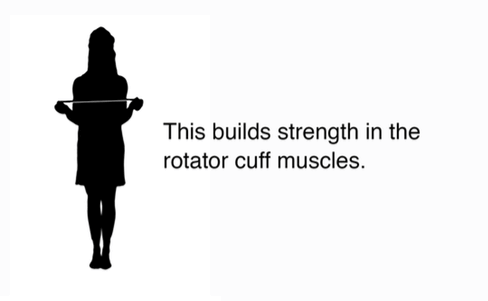
Tags: shoulder pain
